When operational, the community battery will trigger a special Community Battery Credit Offer from our project partner, Diamond Energy, one of Australia’s greenest electricity providers. The offer is an annual $240 credit to eligible Diamond Energy customers for up to ten years, noting that the offer will be available to a limited number of households, with priority given to concession card holders.
Torquay Community Battery
Offer for Torquay residents
Project Overview
Work is underway to install a neighbourhood battery in Torquay, Victoria.
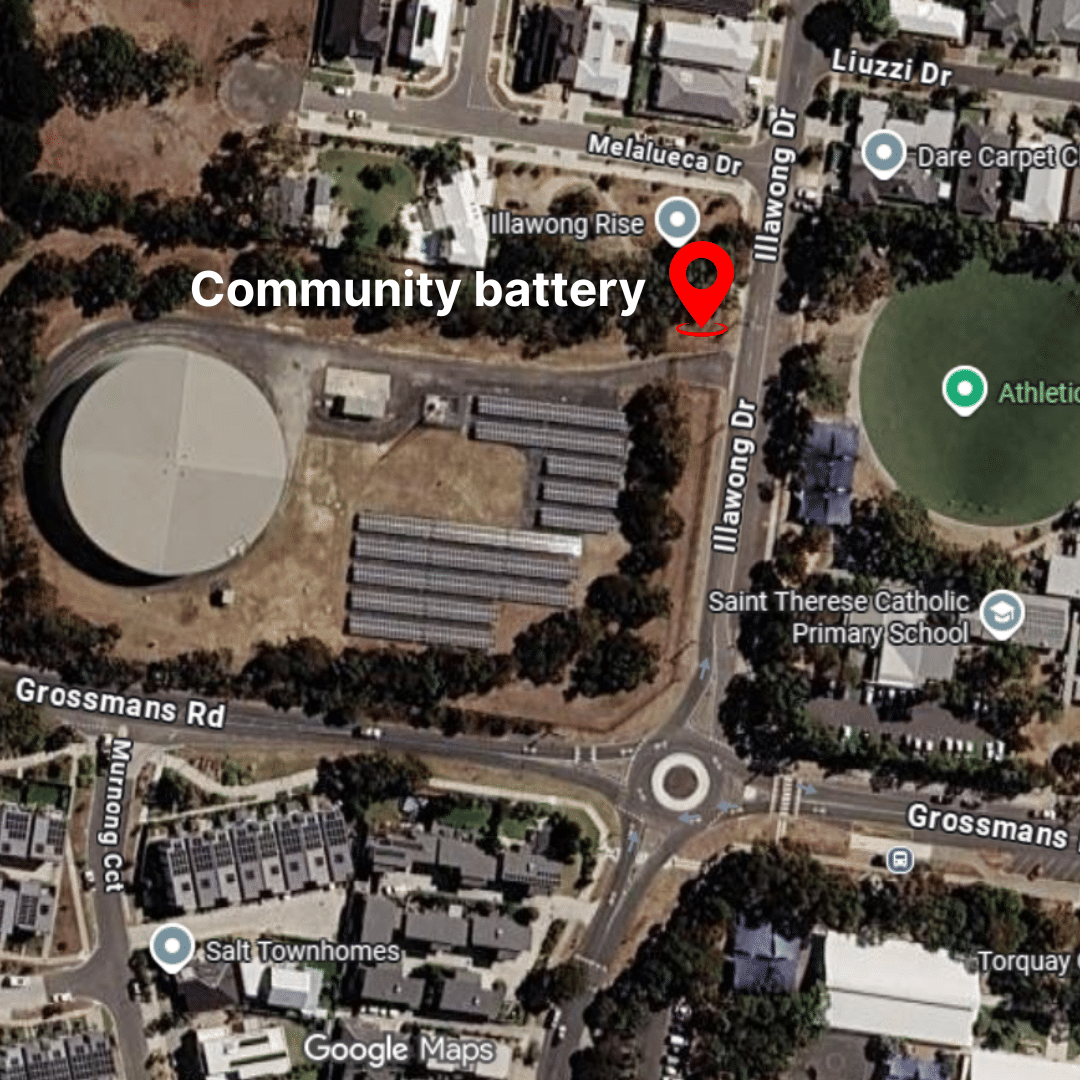
The battery will be located at 11 Illawong Dr, Torquay at the front of Barwon Water’s tank site. The project aims to enable more renewable energy and provide a special electricity retail offer through the project partner, Diamond Energy, for households in Torquay.
The project is funded by a $500,000 grant from the Australian Government through the Community Batteries for Household Solar program.
More broadly, the project also aims to support the benefits of the Australian Government’s program to:
- lower electricity bills
- support more households to install rooftop solar
- allow households who cannot install solar panels to enjoy renewable energy
- reduce pressure on the electricity grid
- absorb excess energy that might cause voltage spikes in the electricity grid
- lower emissions.
To learn more, read our Frequently Asked Questions.
Frequently Asked Questions
What is a neighbourhood battery?
Community batteries, or ‘neighbourhood batteries’, work like large power banks. They are being installed across Australia to capture excess solar energy during the day and release it when demand on the grid is high, such as in the evening. This helps reduce pressure on the electricity grid and supports more households to install rooftop solar. These types of batteries come in many shapes and sizes and can serve many purposes.
These batteries are bigger than a home battery. A typical household battery (often used to store rooftop solar energy) might have a storage capacity of up to about 10 kilowatt-hours (kWh). This might be enough to power your average household for a day. On the other hand, community batteries range from ~40kWh to 20 megawatt-hours (MWh) in capacity.
Community batteries can be connected ‘in front of the meter’ to the electricity network; that is, they are located outside of your home or property and connected to the local network as a standalone unit. A community battery would typically be located at the street level close to where electricity is being consumed and generated.
Community batteries can also be connected 'behind the meter', similar to a household battery, and can be setup to charge from rooftop solar on the same property. Depending on how the battery operates, it can be used to provide backup power.
Community batteries can be owned by electricity distribution businesses or others such as community energy groups, electricity retailers, and private investors. Many batteries trade electricity by buying and selling from the market, and therefore, many batteries (especially if they are larger), will be operated in a way to generate revenue. The owner and operator of the batteries can be the same or separate parties.
Who is the Yarra Energy Foundation?
Yarra Energy Foundation (YEF) is an independent not-for-profit organisation with a huge ambition – accelerate the transition to cleaner energy to address a changing climate.
YEF exists to connect people to better energy. We do it by bringing government, industry, and community together to deliver innovative solutions for energy emissions reductions.
Established by Yarra City Council in 2010, YEF is governed by an independent and highly experienced Board of Directors.
Follow us on LinkedIn
What is the project?
The Australia Government provided a $500,000 grant to the Yarra Energy Foundation (YEF) via the Community Batteries for Household Solar program to install this neighbourhood battery. Yarra Energy Foundation (YEF) is leading the project with our project partner Diamond Energy.
The Community Batteries for Household Solar funding program aims to:
- lower electricity bills
- support more households to install rooftop solar
- allow households who cannot install solar panels to enjoy renewable energy
- reduce pressure on the electricity grid
- absorb excess energy that might cause voltage spikes in the electricity grid
- lower emissions.
The objectives of the project are to:
- Install a battery energy storage system (BESS)
- Provide a special electricity retail offer to local residents, with priority to concession card holders, through project partner, Diamond Energy
- Operate the battery to support more renewable energy in the system and put downward pressure on electricity prices.
Where will the battery be located?
The battery's location is 11 Illawong Dr, Torquay at the front of Barwon Water’s tank site. The site on Barwon Water’s land was chosen due to technical, environmental, and network criteria, including the area’s high level of rooftop solar.
The main criteria that YEF used to select this site include:
- Available space (at least twelve square meters)
- Land ownership / tenure (can we use the land, how may it affect users)
- Safety (safe access, environment, traffic etc.)
- Density of residential solar (local renewable energy)
- Density of residential customers (local energy consumption)
- Technical feasibility (can the electrical system be connected to poles and wires)
- Budget and cost of installation (complexity and is it feasible within the grant budget)
How will the project impact me?
The battery itself will not directly affect your electricity bill, your retailer contract, nor your solar feed-in-tariffs in any way. Most of the changes will happen ‘behind the scenes’ in the local electricity system. The battery will be connected to the grid, like any other property, and will not draw directly from any properties that may export solar energy. Exported energy from any property is likely to be imported and stored in the battery.
Some local residents will have the opportunity to take up a special retail offer from Diamond Energy. When installed, the community battery will trigger a special Community Battery Credit Offer from our project partner, Diamond Energy, one of Australia's greenest electricity providers. The offer is an annual $240 credit to eligible Diamond Energy customers for up to ten years, noting that the offer will be available to a limited number of households, with priority given to concession card holders.
The project is planned to be completed in early 2027, with the construction and installation stages expected to take less than a week. There will be no disruption to electricity supply, and if any road closures or other disruptions occur during construction, we will give you ample notice and minimise inconvenience.
Can I hear the battery?
Neighbourhood batteries can be heard but are generally very quiet and highly unlikely to cause any disturbance. The sources of noise can be the air-conditioning fans which help to cool or heat the ambient air around the battery cells to optimise their efficiency. The second source is the sound of the inverter when it converts AC to DC and vice versa. These sounds only occur when those systems are active.
Noise levels vary depending on the model and operating conditions but typically range between 50 and 70 decibels measured at one metre from the unit. For comparison, 50 decibels is similar to the sound of a quiet conversation at home, while 70 decibels is more like a household vacuum cleaner. Residents near YEF's first community battery in an inner-city residential neighbourhood of Fitzroy have had no issues with noise. We do not anticipate any direct impacts to nearby homes or properties at this location.
Is it safe?
Yes, the battery system is very safe. It uses lithium-ion based chemistry, the same technology in a typical laptop, phone or electric vehicle.
YEF will ensure:
- The battery meets all of the regulatory standards under Australian law
- The battery management system includes its own monitoring and ‘thermal runaway’ (heat event) shut down protocols
- Robust consultation with and input from relevant fire authorities and fire safety guidance
The risk of fire from the battery is extremely low, however we are actively engaging with the CFA to ensure the project reflects best practice safety and risk management. We do not anticipate any direct impacts to nearby homes or properties at this location.
How can I provide feedback?
Formal community consultation activities have closed, however we welcome any other enquiries - please contact us on:
Phone: 03 7037 6040
Email: information@yef.org.au
What problems does a community battery solve?
The rapid uptake of solar is creating ‘congestion’ in the electricity network, meaning more energy is being exported than the grid can handle. Unfortunately, when this renewable energy can’t be used or stored, it’s wasted, or ‘curtailed’.
Community batteries address this problem by absorbing and storing the excess energy from rooftop solar during the day and releasing it in peak times when it is needed most, typically during the evening.
Secondly, with an increasingly variable energy system powered by renewable energy, batteries are needed to 'smooth' the generation and store energy for times when it may be needed most.
Community batteries can provide other benefits, these may include:
- Allowing those without solar, such as renters or apartment dwellers, to access more renewable energy,
- Reducing strain on the electricity network caused by high demand or surplus solar exports (‘overvoltage’),
- Avoiding curtailment of new and existing solar installations, increasing the amount of renewable energy available,
- Enabling greater solar installation uptake in the local area,
- Fostering new social connections by bringing the community together towards a common goal,
- Providing an opportunity for local artwork, placemaking and civic pride,
- Providing network-supporting services such as Frequency Control Ancillary Services (FCAS),
- Minimising the costs of network augmentation services by the Distribution Network Service Provider, and
- Putting downward pressure on power prices by enabling more renewable energy and reducing network costs.
Community batteries have the potential to address diverse issues in the energy system while benefitting the community. They can be a win-win for local energy users, for our electricity network, and for enabling more renewable energy.
Significantly more storage is needed to enable an electricity system powered by a high percentage of renewable energy. This is because a lot of the renewable energy is variable (subject to sun and wind) and batteries can buffer that energy.
How does this community battery work?
Community batteries are still a relatively new part of our energy system. There is currently no single best operating model. Each new system provides an opportunity to explore alternative features, operational models, and benefit-sharing. This battery will connect directly to the grid, just like a normal home, supporting the wider network and surrounding community by storing and releasing energy.
Generally, our model of community batteries operate with these principles:
- The community battery is connected to a ‘low-voltage network’ which can typically connects between 50-200 premises. The shape of each low-voltage network is different, but they often extend only a few streets from a ‘distribution substation’, which connect that network to the rest of the grid. Like homes and businesses already connected to the network, the community battery has a meter that measures its imports and exports.
- The community battery charges (imports energy) during the peak solar generation hours during the day, usually between 10am-4pm when daily prices are typically lowest. A neighbourhood with lots of solar generation and low energy consumption during the day (i.e., most residential areas) is likely to have surplus solar energy. A community battery can help absorb that energy and store it for when it can be better utilised. This also helps to reduce local ‘overvoltage’ issues from too much solar exports during the day and allows more renewable energy to be produced and consumed locally.
- The community battery typically discharges during the evening peak demand period (usually 5pm–9pm), when prices are typically highest, reducing the demand on the network and offsetting predominantly fossil fuel generated electricity in the evening.
- The community battery is not directly connected to any other premises – it has its own meter, much like a home or business, and there is no subscription or service fees charged/credited to local households. The battery also trades on the electricity market via a retailer. Engaging in ‘wholesale arbitrage’ (buying and selling electricity) allows the battery to generate revenue.
- The community battery may also generate revenue through the network-supporting Frequency Control Ancillary Service (FCAS) market.
Can I use the battery to store the energy I export for later use?
No, the community battery does not function like a traditional home battery.
Instead, it is connected directly to the grid through the local low-voltage network (the poles and wires near your home). The battery charges (buys electricity) and discharges (sells electricity) to the grid. While you cannot store your exported energy specifically for your own use, the battery is designed to store a higher proportion of locally generated solar energy during the day and discharge it back into the same local network, typically during the evening when demand is higher.
Will the battery reduce my energy expenses?
The battery does not directly reduce a household’s energy expenses, as your household’s export and consumption prices set by your personal energy retailer will remain unchanged.
However, the more batteries operating on the grid, the more downward pressure on energy prices. This is because renewable energy is typically cheaper than fossil fuel energy, and by increasing the renewable energy content in the electricity network, the overall cost of energy should reduce.
The battery also reduces the need for network upgrade services carried out by the Distribution Network Service Providers, the savings of which should transfer to consumers in the form of lower network fees.
Some local residents will have the opportunity to take up a special retail offer from Diamond Energy. When installed, the community battery will trigger a special Community Battery Credit Offer from our project partner, Diamond Energy, one of Australia's greenest electricity providers. The offer is an annual $240 credit to eligible Diamond Energy customers for up to ten years, noting that the offer will be available to a limited number of households, with priority given to concession card holders.
Will there be any cost to residents?
There is no cost to residents and the battery does not impact your feed-in-tariff from solar exports, and you do not need to alter your energy retailer.
Will there be any changes to my electricity supply?
No, there will be no changes to your electricity supply incurred by the operation of the battery. Your supply will function as normal. For customers with solar panels, feed-in-tariffs will not be affected in any way by the community battery.
Will there be any road closures or disruptions to my electricity supply during the project?
The project will not cause any disruptions to your electricity supply. If any road closures or other disruptions are required during construction - which is expected to take less than a week - YEF will work closely with project partners to ensure all necessary procedures are followed, including providing ample notice and minimising inconvenience.
For information about the project please email information@yef.org.au or call (03) 7037 6040.
Community Engagement
YEF has completed community consultation activities including:
- Letter drops to the surrounding residential properties
- Feedback survey open for 12-months (now closed)
- Two online drop-in information sessions (held August 2025)
- Invite to join a Community Reference Group (YEF did not receive enough interest from community stakeholders to form a Community Reference Group)