Hot water emergency? Read this before you pick another gas system

Have you ever heard that it’s cheaper, easier, and faster to replace your old gas hot water heater like-for-like?
According to a Grattan Institute report, approximately 9 out of 10 households in Victoria with a broken gas hot water system replaced it like-for-like.
But is sticking with gas in a world of rising gas prices really the best option for most households? We’ve investigated a likely real-world situation for many Victorian households comparing gas storage hot water systems vs electric heat pump hot water systems.
Let’s break it down.
Upfront costs
Gas storage hot water systems
As with all jobs that require a tradie, the exact cost will come down to your home and your specific circumstances. So, we looked at some averages.
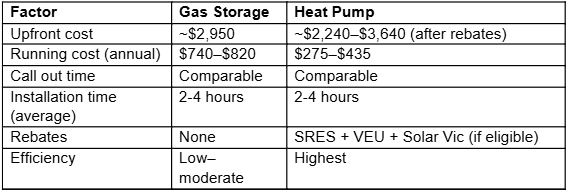
With no luck finding prices online, we contacted 10 local plumbers and provided photos of a 15-year-old 170L gas storage hot water system. We got 6 quotes for a home in metropolitan Melbourne ranging from $2,400 – $3,600, giving us an average cost of $2,950.
There are no state or federal rebates available for gas hot water systems, so the entire cost is covered by the homeowner.
Heat pump hot water systems
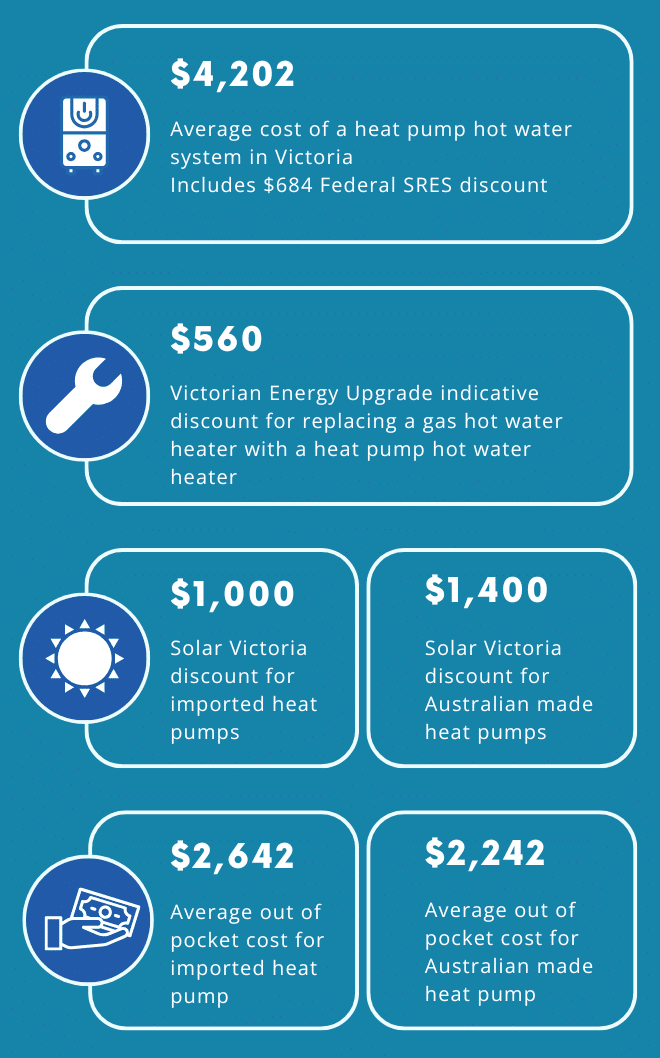
Like gas systems, we didn’t find any companies providing pricing on their websites, but according to this article by Solar Choice, the average cost of a heat pump hot water system in Victoria is around $4,202. This average cost includes the federal rebate from the Small-scale Renewable Energy Scheme(SRES).
For those based in Victoria, there are two additional rebates available. The first is through the Victorian Energy Upgrades(VEU) program, which provides Victorians with discounts on energy-efficient products.
The VEU’s stated indicative discount for replacing a gas hot water heater with a heat pump hot water heater is $560. Which brings our average down $3,642.
The second rebate, available through Solar Victoria, is means tested and does have other eligibility criteria. If eligible, there is an additional $1,400 discount on Australian made heat pump hot water systems, or $1,000 off imported heat pumps.
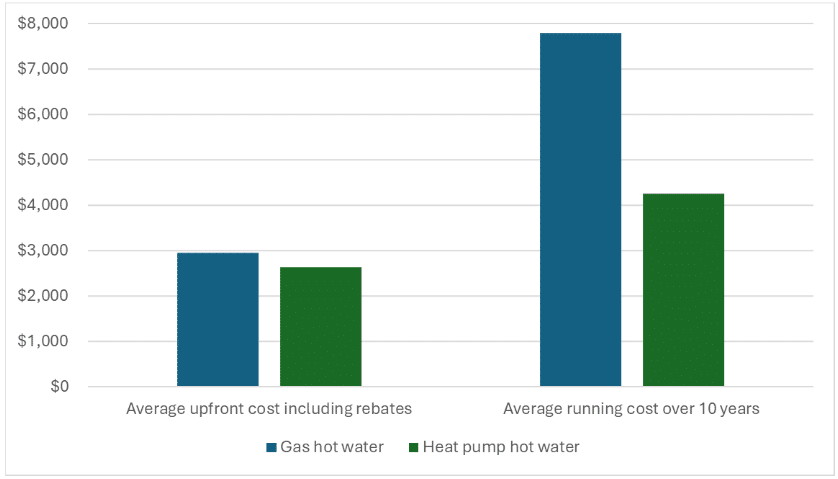
This takes our average down to $2,242 for an Australian heat pump, or $2,642 for all other heat pumps.
We note that premium heat pumps can range from around $5,500 – $7,000, so if you removed these from the data, a reasonable average mid-range heat pump price could be closer to $3,000 (including SRES), or $1,440 after VEU and Solar Victoria rebates.
Summary:
- In many cases, with both Victorian rebates included, a heat pump hot water system will cost less upfront than an equivalent gas storage hot water system.
- The upfront cost could be in the realm of ~$500 – $1,500 less on average (depending on your situation).
- If ineligible for the Solar Victoria $1,000 – $1,400 rebate, the average cost of a heat pump hot water system could be similar to the gas equivalent, or ~$600 more if looking at a mid-high-end product.
But this is only part of the picture, how expensive are they to run?
Running costs
According to data from Sustainability Victoria, an average four-person household, connected to mains gas, will spend between $740 – $820 each year to run their gas storage hot water system.
The same four-person household with a heat pump hot water system will spend between $275 – $435.
That’s a difference of $385 – $465 annually, or $3,850 – $4,650 over 10 years.
If you have rooftop solar, or you’re on an off-peak energy plan, your savings can be even greater. A key advantage of heat pump hot water systems is that they can be set on a timer, allowing you to heat your water at the time of day when energy is cheapest for you.
You can even think of these units as thermal batteries on the side of your home, storing low-cost solar energy as hot water that you can use later in the day.
Time to install
Your shower’s running cold and nothing feels more urgent, especially if you’re living with teenagers who can’t survive without a long, hot shower. So, wouldn’t it just be quicker to replace your old system with the same type?
The fact is, any in-stock hot water system can be put in the next available van, regardless of what type it is. But of course, factors like stock availability and service bottlenecks can apply, but they can apply to gas systems too.
After working with installers for many years, we have had stressed phones calls one day, and new heat pump hot water systems installed the next. We can’t say it will always be that quick, but fast turnarounds are just as likely for heat pumps as they are for gas.
If the rebates are your concern, there are systems in place to deal with exactly that.
While under normal circumstances Solar Victoria would check your eligibility before your install, for emergency hot water jobs, you do not need to wait and can apply for the rebate afterwards.
Both the Federal SRES and Victorian VEU rebates will be applied by your installer on the day of install, and there is nothing required ahead of time that would slow things down.
Summary
- Turnaround times for heat pump hot water systems can be just as quick to source and install as gas appliances.
- We have seen no evidence to suggest heat pumps would be slower than a like-for-like gas appliance but acknowledge a variety of factors may impact call out times in your context, such as location and installer availability.
Switchboards
Will you need to upgrade your switchboard to make the change from gas hot water to a heat pump?
In most cases, no. Heat pumps typically run on a standard 10-15 amp circuit, so the main electrical work is adding a new dedicated circuit with a safety switch (RCD). The majority of homes will have space in their switchboard for this, so it’s a straightforward job.
If your switchboard is very old and can’t accommodate modern safety switches, or it is already full, then you will either need an upgrade or, in some cases, a new switchboard.
As hot water heat pump installs already require both an electrician and plumber on site to complete the works, you won’t need to source a separate trade for any required switchboard works.
Installers
Most plumbers are licensed and trained in gas systems, but not all install heat pumps, which explains why so many households replace like-for-like. So, what if your local plumber doesn’t work with heat pump systems? How do you know who to trust?
Our advice, start with your Council. For many Victorians, your local Council has already done the hard work for you, and you can rely on their vetted supplier panel.
Some of these programs include:
Solar Savers– involving twenty councils across Victoria
Goulburn Murray Solar Savers– involving a further seven councils
Hume Home Energy Upgrades– for residents in City of Hume, run by YEF
Love Bayside, Home Energy Upgrades Program– for residents in City of Bayside, also run by YEF
Yarra Home Energy Upgrades– for concession card holders in City of Yarra
There are also comparison websites such as Solar Quotes, or the My Efficient Electric Home Facebook group, where you can ask others for their recommendations or reviews.
In some areas, local community energy groups provide guidance and installer information, such as:
Electrify Boroondara– City of Boroondara
Clean Energy Nillumbik– City of Nillumbik
Repower Mornington Peninsula– Mornington Peninsula Shire
Electrify Yarra– City of Yarra
Healesville CoRE– Healesville and surrounds
A note about rentals
If you’re renting, we know you currently have very little control over the type of hot water system installed in your home. But from 1st March 2027, new energy efficiency standards will come into effect. When a hot water system in a rental property permanently fails, it will need to be replaced with an energy-efficient model.
If your hot water system fails before then, you can still make the case to your landlord. The household will receive both the Federal SRES and Victoria VEU rebates on a heat pump hot water system, but unfortunately the $1,000 – $1,400 Solar Victoria rebate is only available in owner-occupied homes.
The bottom line
When your hot water system fails, it’s easy to assume that sticking with gas is the simplest option. But for many Victorian households, a heat pump hot water system can be just as fast to install, cheaper to run, and often comparable or cheaper in upfront costs.
While all sources quoted in this article are based on Victoria-wide data, we note that our own experience working with installers, and the 10 plumbers contacted for gas hot water system quotes, are all based in metropolitan Melbourne.
We also note that gas storage and heat pump hot water systems are not the only hot water systems used in Victoria. Gas or electric instantaneous, electric resistive and gas or electric boosted solar are all seen in Victorian homes. While upfront and running costs of each system will vary, heat pumps are the most energy efficient system available.