EV charging in apartments: is it simpler than we think?

There are lots of options on the market for EV charging, but what charging capacities do most of us really need? It’s possible that the humble power point could be the unsung hero for many apartments and multi-unit dwellings.
As EV uptake rises across Australia, how will people living in apartments meet their charging needs? We’ve noticed a spike in interest specifically for apartments.
To explore this, we spoke with several subject matter experts to understand what might be changing.
Jo Oddie Vice President of the Australian Electric Vehicle Association (AEVA) shared insights into how the landscape is shifting.
‘What’s changed, well firstly, there’s more public charging out there, … then CCS2 is becoming the standard type of connector for EVs, with adaptors available for older EVs (such as Chademo port Leafs), and apps like PlugShare are available to see where and if public chargers are working.’
However, it should be noted that public charging still has a way to go in covering regional gaps. Jo sees local governments having an important role in designing and enabling the public charging network.
For private charging, she highlighted an often-overlooked fact, which is that EVs can be charged from a standard power point – no need for a specific EV charger.
While faster charging options with higher kilowatt per hour capacity are available, charging from a regular power point is both safe and convenient.
The Australian Government provides further information on this here. Simple education points like this are something Jo highlighted as essential for expanding EV charging in apartments.
Owners Corporation Network of Australia (OCN) and the Electric Vehicle Council (EVC) have developed a document called “what does fair look like” in existing strata, similarly supporting the use of the standard power points for EV charging.
Charging behaviour is another important piece of the puzzle. Many people can meet their everyday driving needs by ‘trickle’ charging overnight at home and use public fast chargers only when needed.
According to the Australian Government’s information on Electric vehicle charging equipment “The average Australian driver travels around 33 km a day which will typically not use more than 10% of an EV battery’s capacity”. Understanding this can really help simplify the conversation about apartment EV charging.
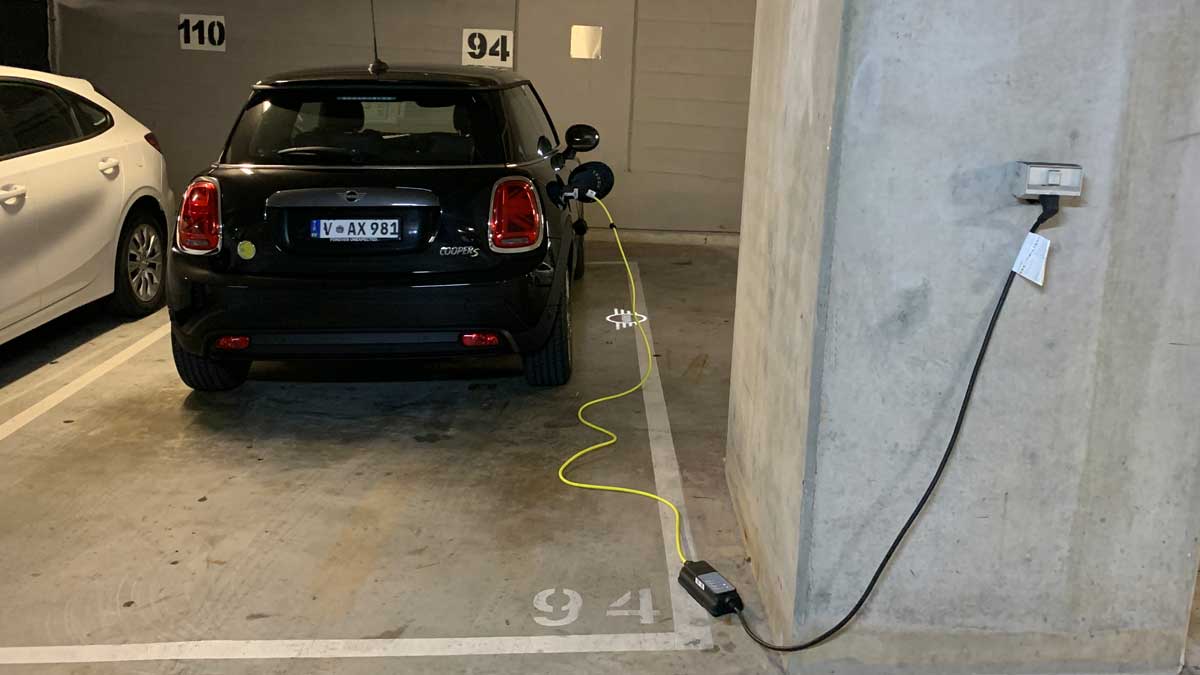
For example, many residents may only need a standard power point or an AC (slow) charger, rather than more complex and expensive DC (fast) charging infrastructure. Looking at Figure 1, the estimated costs for AC and especially DC charging infrastructure increase significantly compared to a standard power point. So, understanding what type of charger apartment dwellers need is very important for the financial viability of the project.
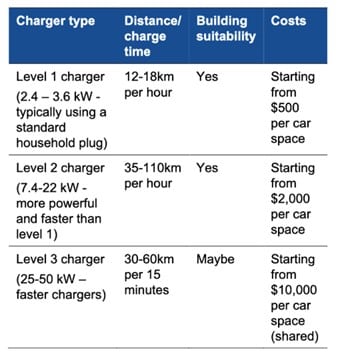 Figure 1: Comparison of estimated EV charger prices from Victorian Government Fact Sheet November 2023 ‘EV-ready buildings for owners corporations’
There can also be benefits for residents who don’t currently own an EV.
Fred Tuckwell, Chair of the OCN pointed out that when ‘EV chargers are installed, power points can also be added to car bays or storage cages.’ He suggested these can be used to run other devices, creating broader value for residents and making these projects more appealing for entire apartment buildings. Owners corporations will need to provide guidance on safe charging practices.
Generally, the higher total combined charging capacity you want for your apartment, the more likely the need for upgrades to switchboard, cabling and other infrastructure, which will impact cost. However, each individual building will have unique circumstances. Again, the humble 240V socket may be slower, but significantly more feasible and cheaper in the context of an entire installation.
Grid capacity is another aspect to consider. Wendy Russell, a research fellow with The Australian National University Centre for Energy Systems in the School of Engineering, highlights that ‘EV charging will put a lot of pressure on the electricity grid as EV uptake increases. Trickle charging is important for reducing the peak demand of EVs, and even more so if it’s demand managed.’ This is particularly important for apartment buildings considering that their own electrical system will have capacity constraints. It should also be noted that EVs can be used to soak up solar energy if they are charged during the day, which can better enable use of solar and reduce network strain.
Of course, infrastructure decisions in apartments aren’t just technical, they’re governance decisions too.
If we look at policy changes in the Australian context, one change has occurred in the ACT. The ACT government’s Making your Strata Building EV Ready explains how they amended The Unit Titles (Management) Act 2011 ‘to facilitate residents installing sustainability infrastructure in buildings managed by an owners corporation or strata manager. This update ensures that owners corporations cannot unreasonably prevent or restrict the installation of sustainability infrastructure, such as EV chargers.’
Practically this means that sustainability upgrade projects put forward by residents must be considered and will be considered like any other upgrade. This is a small step in the right direction. However, in terms of real impacts for accelerating sustainable upgrades this is yet to be seen. Although, it sets a precedent that these issues are important and valued by government and will be increasingly so.
Another area of policy that is changing is voting thresholds for strata. One challenge that’s unique to apartments is their ownership structure. Owners’ corporations or strata managers are responsible for managing common property, which means changes often require collective agreement from owners in the building.
In Victoria, for example, installing EV chargers usually requires 75% of all owners to vote in favour of the proposal as per the Department of Energy, Environment and Climate Action’s EV-ready buildings for owners corporations. This includes all owners regardless of if they have attended meetings about the proposed change or not.
In July 2025, however, New South Wales lowered their voting threshold to a simple majority for sustainable upgrades such as EV charging. It was clear to Fred that this has made the process of approving EV charging in apartments materially easier.
The Victorian Government recently opened for submissions a Parliamentary Inquiry into renewable and affordable energy for apartments (closed 27 February 2026). We hope they will consider similar changes to NSW.
While lowering voting thresholds may accelerate installation, it also raises important questions about fairness. Wendy (ANU) stressed that in strata-managed buildings, residents who don’t have the capacity to participate in meetings may end up bearing the costs of upgrades they didn’t expect, agree to or can afford.
It’s important that we try to tackle this changing landscape equitably, encouraging apartments to have charging but not placing extra burden on those who cannot afford it.
If we look further abroad, internationally ideas like ‘The Right to Plug’, commonly used in Europe, are starting to gain traction. In Australia, we’re seeing similar conversations emerge around ‘The Right to Charge’. According to ChargeUp Europe,
‘The Right to Plug grants anyone the ability to easily install an EV charger at home or at work without unnecessary administrative burdens.’
This concept goes a step further than the ACT’s amendments to the Unit Titles Act 2011, aiming to further reduce barriers in particular to EV charging. We’re also starting to see experts and leaders at the forefront of Australia’s EV industry, including the Australian Electric Vehicle Association (AEVA), talking about these ideas and what they could mean locally.
Read more about AEVA’s position on ‘the right to charge’, a concept that can help us reimagine our current infrastructure and help push EV charging into the forefront of policy.
We are seeing governments across Australia fund several initiatives to help tackle apartment electrification (with EV charging being one aspect) such as:
-
The Parliament of Victoria Inquiry into renewable and affordable energy for apartments.
-
The ACT government’s ‘Sustainable Apartments Pilot’ (feasibility studies for 7 apartments).
Apart from charging behaviours and knowledge about individual consumer needs, one important education piece is quelling the myth around EV fires. Fred Tuckwell (OCN) pointed to existing data that shows the fire risk from EV charging is low. In fact, OCN reinforces in their fact sheet based on an ACCC report ‘road registered EVs have one twentieth the fire risk when compared with internal combustion engine vehicles (ICE)’. This has also been shown in international data by Arup.
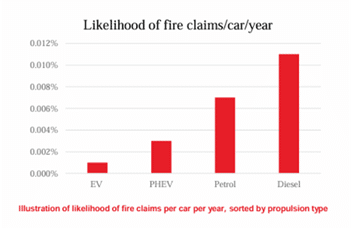 Figure 2: Graph of fire claims of different vehicle types from Arup Report 2023 ‘Electric Vehicle and Charging Infrastructure’
These studies will be informative for Owners Corporations making decisions around EV charging infrastructure, reducing uncertainty, and having informed discussions about collective risk.
Overall, installing EV charging in an apartment building may be simpler than you think. That’s not to say it’s inherently easy, apartment buildings come with their own complexities. But if we take the time to plan properly and understand our real charging requirements, the solution may be more straightforward than expected.
In some cases, a standard power point could be enough. This reduces both costs and infrastructure requirements compared to installing higher kW chargers. There can also be broader benefits. Residents who don’t own an EV can still make use of power point installations, which may make a proposal more attractive to more owners.
The key takeaway? We don’t necessarily need the highest capacity chargers for everyday use. We support the call for ‘right charger, right place’. Given the inherent complexities of apartment buildings, focusing on practical, right-sized solutions could be a way forward for EV charging in apartments.
Written by Bella Kocis
Did this pique your interest? Learn about a positive strata experience with this article from the AEVA: A positive strata experience – 12-07-2025 : Australian Electric Vehicle Association in Australia